This week’s question comes from a viewer who writes: “I’ve really enjoyed your podcasts, they are all very informative. I recently found myself more exited about woodworking. Though I’ve had an interest since childhood, I never really had the resources, till now (my wife also supports my dream). Anyway, I was watching one of your podcasts and you mentioned a recipe for making your own sanding sealer. Would you mind repeating that on an e-mail, or even easier, remind me what episode I’ll find it. Thank you so much for the added inspiration, though I’m starting later in life than you (36, I know this is going to be a lifelong passion. Once again thanx Marc keep it up!!”
And this was my response:
“You just can’t underestimate the importance of spousal support in something like this. I know far too many people who have to work against the grain just to get a new tool. That doesn’t seem like much fun, lol.”
“As for a sanding sealer, I usually just use shellac. Typically a 1 lb cut. There are two ways to do this. I either buy pre-mixed shellac (Bullseye SealCoat), and dilute it from 2lb cut to 1lb cut. Or I simply but dry shellac flakes and mix my own using denatured alcohol. So its not a true sanding sealer by definition, but it accomplishes the same thing. Oh and just a word about true sanding sealers. In general, they contain material that can interfere with finish adhesion to a small extent. The stuff that makes it easy to sand is the same stuff that can weaken the bond of the finish to the surface. So in general, I stay away from commercial sanding sealers. Shellac on the other hand, provides a great base for just about any finish. Hope that helps.”
Free from Marc
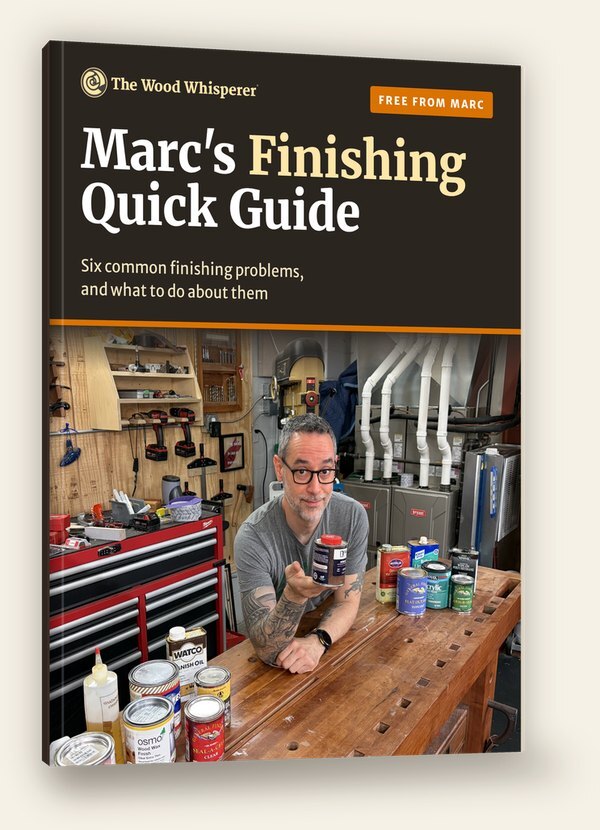
Marc’s Finishing Quick Guide
The finishing mistakes Marc sees most, in one printable guide. Big, easy to read type, made to tape to the shop wall.
- Picking the right finish for the job
- Scratches that show up after the finish goes on
- Blotch control
- Real dry, recoat and cure times
- Rough final coats
- Why switching products usually isn’t the fix
Thanks! Check your inbox, the guide is on its way.
Something went wrong. Please try again.
We will email you the guide. Unsubscribe any time.

Want to watch it done? Wood Finishing in Practice
11 Guild lessons, over 7 hours: oils, hardwax oils, wiping varnish, water-based, lacquer, spraying, outdoor and workbench finishes, all on real furniture. $49.
Prefer to read? Marc’s finishing book, $10